.

Monday, 4 April 2011

Size Matters.

0

Understanding why size matters!

There are many people who have dogs who don’t realize what and ideal weight for their pet is. Thanks to Purina, The Body conditioning tool shows us exactly what an ideal build is.  

It is hard to be able to see an ideal build on a dog with a big coat, although you still should be able to feel through the coat.

Obese dogs have shorter life spans than non-obese dogs. Obesity can lead to a number of health problems. Excess weight puts excess stress on your dog's heart. When the heart doesn't function properly, other organs may suffer including the brain, lungs, liver and kidneys. Over time, these problems may become severe enough to cause life-threatening conditions. 


1     Severely underweight - Too Thin
  • Ribs, backbone  and hips all highly visible even from a distance.                             
  • Obvious muscle loss particularly around the shoulders and thighs.
  • Severely exaggerated waistline.
  • Tummy non existent.
2    Thin - Too Thin
  • Ribs, backbone and hip bones easily seen no overlaying fat layer.
  • Some mild muscle loss particularly around the shoulder and thighs.
  • Exaggerated waistline.
  • Severe tummy tuck.
3      Slightly Underweight - Too Thin
  • Ribs can be felt and may be seen, with backbone and his just visible, no overlaying fat layer
  • Obvious waistline
  • Marked tummy tuck

4    Ideal =-D
  • Ribs can be easily felt and may/may not be seen with minimal layer of overlaying fat
  • A clear waistline can be seen
  • Noticeable tummy tuck 

5    Ideal =-D
  • Ribs can be easily felt and may/may not be seen with small layer of overlaying fat
  • A clear waistline can be seen
  • visible tummy tuck

6   Slightly Overweight - Too Heavy
  • Ribs can be felt but generally can’t be seen, an obvious layer of overlying fat
  • Waistline is visible but not clear
  • Tummy tucks slightly upwards towards back legs

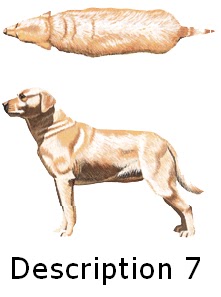
7    Markedly Overweight -Too Heavy
  • Ribs are hard to feel and see, under a thickened layer of overlying fat.
  • Distinct pads of fat can be felt along the lower back and the base of tail.
  • Waistline absent can be difficult to see
8    Obese - Too Heavy
  • Ribs are very difficult to feel under a very thick later of overlaying fat.
  • Chunky pads of fat can be felt along the back and at the base of the tail
  • Waistline is absent
  • Tummy bulges outwards and may sag downwards

9     Clinically Obese - Far Too Heavy :-(
  • Ribs are impossible to feel with a marked layer of very think overlying fat.
  • Very chunky pads of fat can be felt along the back and at the base of the tail, as well as round the neck and legs
  • Waistline is absent
  • Tummy distinctly bulges outwards and sags noticeably downwards.
Thanks to Pro Plan my dogs now have a shiny and well nourished coat and the energy that they need to perform.
I picked Pippa up when she was 16 months old.  I would say she was matching description 1-2, very underweight. Her coat was brittle and dry with no shine. Now she has a lovely fine Soft silky coat and is a much happier dog.


Read more

Tuesday, 15 March 2011

The warm up.

0

Warming up
Do you warm your dog up?

Some people may now be thinking. I never warm my dog up, nothing has ever happened. Or, I walk my dog to the ring.

During an agility run dogs perform many different movements to negotiate a course. A big majority of the time these are performed at high speeds. If the dogs muscles, tendons and joints are not conditioned properly to the demand that they are asked to meet (not warmed up properly) before competition and training you are exposing your dog to the risk of injury. We all probably know someone who has a dog that has pulled a muscle and just how long it can take to get back to full fitness. Therefore why do people still not warm their own dogs up? 

I asked this question to a number of people, people from all grades. The most common answer was “I forget”. Ok, you may forget. So why not set yourself a routine?

Our dogs use all of their muscles to turn, jump, weave and run. Our dogs are effectively athletes! Do you ever see an athlete not warming up before they race?
An athlete warms up to prepare the muscles and joints for what is about to come. They are ‘warming them up’ by moving and stretching the muscles and joints, increasing the blood flow to the muscles. In a warm muscle the nerve impulses travel faster and the body reacts quicker also the muscles glide against each other better, which makes them move quicker and more precise. A warm muscle is less prone to sprains and ruptures than a cold one.  We are getting the dogs mind and body in tune to cope with the physical and mental demand.

 As the dog becomes older the muscles, tendons and ligaments may become stronger, shorter (if not warmed up) and more rigid. This means that they will be more prone to injuries, if they are worked hard and not warmed up. Therefore, the older the dog the more important the warm up is. It doesn’t take long so why don’t people do it? How long do you normally stand in a queue? 10 minutes +


The first section of a warm-up should aim to increase the physical and metabolic rates in the body. This means we should be looking to increase the heart rate and breathing. The muscles will be cold so we need to warm them up, get them working and warming up gradually.
This is my warm up routine.

  1. Walk- gentle trotting pace. Roughly 2- 3 minutes
  2. I then do some heelwork, to get my dogs focused on me. Roughly 1 minute
The second section of the warm-up is stretching.

 Muscles, connective tissue, tendons and the ligaments of the joints all need to be stretched..  The stretching exercises the muscles tendons and ligaments to reach their maximum length which means that the muscles and joints will be flexible. The flexible muscles and ligaments enable the dog to spin, jump and turn quickly, smoothly and accurately without the risk of spraining or tearing the muscles, tendons or ligaments by sudden twisting or stretching. I begin this section by laying my dog on his side and rubbing all over his body, mainly focusing on the neck, ribs,front and back legs. I continue rubbing until I feel my dogs body warming up, this helps get the blood flowing round the muscles. I then make sure i stretch my dog, below are some of the stretches i do with my dogs.


It's importnt to note that I don't apply lots of pressure when extending my dogs legs, if my dogs were to twich i would try once more, carefully. If they still do not want to extend the leg i would then contact Christine, McTimoney treatments.

I will then do some left and right turns, leg weaves, heal work, send arounds. I will look for movements that will be needed within the run.

People stand queuing for 10 minutes, people always moan about queue lengths. Queuing is never going to change. Why not use the queuing time to do something that is beneficial to the dog?

Read more

Friday, 4 March 2011

MOT time - Getting the dogs checked.

0

Getting my dogs checked.


Dogs tend to act first and think later, especially when working in a sport they love. A dog will generally give you their all, whether they are suffering any pain or discomfort. Sometimes when your dog is suffering any sort of musculoskeletal pain you may notice that it cries out or perhaps doesn't work or move as well as it normally does. However, you may not notice that there is any obvious problem, so it is a good idea to have your dog checked over every so often just to ensure that your dog is functioning to 100% of its potential. I have my dogs checked over by Christine East a McTimoney Animal Practitioner.

I make sure that I get my dogs checked at least four times a year, even if I think there is nothing wrong. I know personally how uncomfortable it is when something is just out of place, having a leg a little bit shorter then the other means that my muscles can sometimes over compensate and become really tight. If they become tight and out of position it causes pain, when the muscle is extended.  My dogs are athletes. I feel it is my job to make sure they are sound before training and competing.


Why McTimoney

McTimoney is a type of chiropractic that uses low force and high speed adjustments. This means that the adjustments are very gentle and usually don't cause any discomfort, making them highly suitable for dogs.

A McTimoney Practitioner will assess your dog's skeleton to check for symmetry and will also check its muscles for tension, soreness and asymmetry. All practitioners work differently, they should always work on the muscles to remove tension and then mobilise joints to free up the whole body to make them move more easily. This is why I prefer Mc Timoney as they relax and warm the muscles before the main treatment. I don’t want my dogs experiencing any pain. They then use McTimoney to realign any bones in the skeleton that are out of position. My dogs love the massage first it helps them relax. I know Ben especially loves her treatment as he greets Christine and the door and then runs to the room and stands on the rug (where Christine treats him). I know be would not freely go to a place he didn’t want to be.


The dogs can be a bit sleepy for the rest of the day, although the treatments have never affected my dogs. You should keep the dog quiet to ensure that the treatment has maximum benefit. I give my dogs a lazy day. No walk just rest. Then introduce a smaller walk the next day, nothing too intense for 48 hours after the treatment. Then it’s back to the normal exercise and training.

 I know that my dogs bodies are in full working order and that they have nothing out of place.


Christine East is highly recommended by many people doing Agility, Obedience and Flyball. She is based in the Lincoln area but does travel. For more information contact Christine on christine.east@btinternet.com

Read more

Thursday, 24 February 2011

Physical & Mental Preparation

0

I have been thinking about writing a blog for a while. It has been one of those things, I’ll do it later..Next week! Finally it’s here. Started, scheduled in and its going to carry on!

Instead of starting off my blog on what you all would be expecting read about. – (Agility training techniques) I’m taking a step back. I want to share with you exactly what my dogs and I do away from the ‘agility training’, for preparation.

I am focusing a series of blogs on training. physical and mental preparation and conditioning, for both human and canine. What both my dogs and I do to make sure we can keep on our top form. You will find many of the top agility handlers have good mental and physical preparation. That for us starts away from the agility scene and focuses on getting fit and maintaining the form.

Agility is getting more and more competitive, turning into a more of a sport. Nothing comes easy now. My favourite quote at the moment is ‘The sleeping fox catches no poultry.’ 

The very foundations of our training, before Agility.

Hydrotherapy
What are the Benefits?
Hydrotherapy can dramatically help with the rehabilitation, it has special effects on the body’s tissue therefore increasing the chance of a successful return to their full fitness.

Hydrotherapy should follow a programme that is individually tailored to your dogs needs. It should take include a warm up and a cool down, as well as taking into consideration the role of the dog, especially if they are a performance dog i.e. Agility, working trials, sledge dogs
There are specific aqua and hydrotherapy techniques that can be incorporated. This is to help improve speed, agility and endurance as well as improve proprioception. The hydro therapist should be looking for controlled, good quality movement rather then just flat out speed swimming.

When the dog is swimming most of the muscles normally used in movement are being worked without the stress that is caused by motion on hard ground.

What does this mean?
Each step creates a shock wave which the travels up the limb, which is then absorbed by the bones, joints and tendons. Our dogs need these stresses to retain healthy and strong bone. Although, if the stresses are too repetitive the limbs can be damaged and weaken.
However hydrotherapy allows a more increased resistance to movement, without the pressure of exercising on hard ground. This means that the muscles have to work harder then they would do out of the pool.
Hydrotherapy is great for;
  • Muscle strengthening and maintenance
  • Increasing the range of movement within the joints.
  • Relief of pain, swelling and stiffness
  • Improved circulation
  • Helps increase the healing of tissue and the speed of recovery.
  • Cardiovascular workout, Great for the heart and lungs.


Why is swimming in a pool better then the river?
Swimming your dogs at a hydrotherapy pool is better as the warm water increases the circulation of blood to the muscles, which increases the supply of oxygen to the muscles and flushes away the waste products. This makes the muscles relax and will help to reduce pain and stiffness. For a dog carrying an injury or swelling, the improved circulation will reduce swelling around the injured area, therefore enhances healing after injury. Hydrotherapy should follow a programme that is individually tailored dog. looking for quality movement, not just speed. A dog will not think about movement when chasing a ball, in a river. Although it still is a good form of exercise.
Why do I take my dogs to Hydrotherapy?
My dogs work hard to negotiate all of the obstacles within an agility course, as well as the training. Their muscles, bones and tendons are pushed to their maximum to jump weave, get the turns and the stop on the contacts. I feel with their regular walks and training the dogs bones take a lot of impact, which is why I like to take them.
The fact that they ‘work out’ and build muscle without putting pressure on their joints is the main reason I swim my dogs, to maintain the muscle, strengthen them and keep the good movement in the joints. It’s also a little treat for them too, as they love it!
I make sure that I train my dogs for no more then an hour and half each week, as I feel repetitive training can lead to unnecessary impact on the joints, muscles and tendons. I want my dogs to last as long as possible! My dogs are PETS before they are agility dogs.

                                               DOG WISE HYDROTHERAPY
Louth.
I would like to say a massive thank-you to Ann & Rod Norton at Dog Wise Hydrotherapy for swimming my dogs, you are fantastic with them and they LOVE coming to swim with you.

 Also please note.
The dogs pictured above are not my dogs. Unfortunately my camera lenses steams over so I was unable to produce and quality photos. So, another big thanks to Katie McManigan for letting me share there fantastic photographs.

Lucy Osborne.


Read more

 
Powered by Blogger